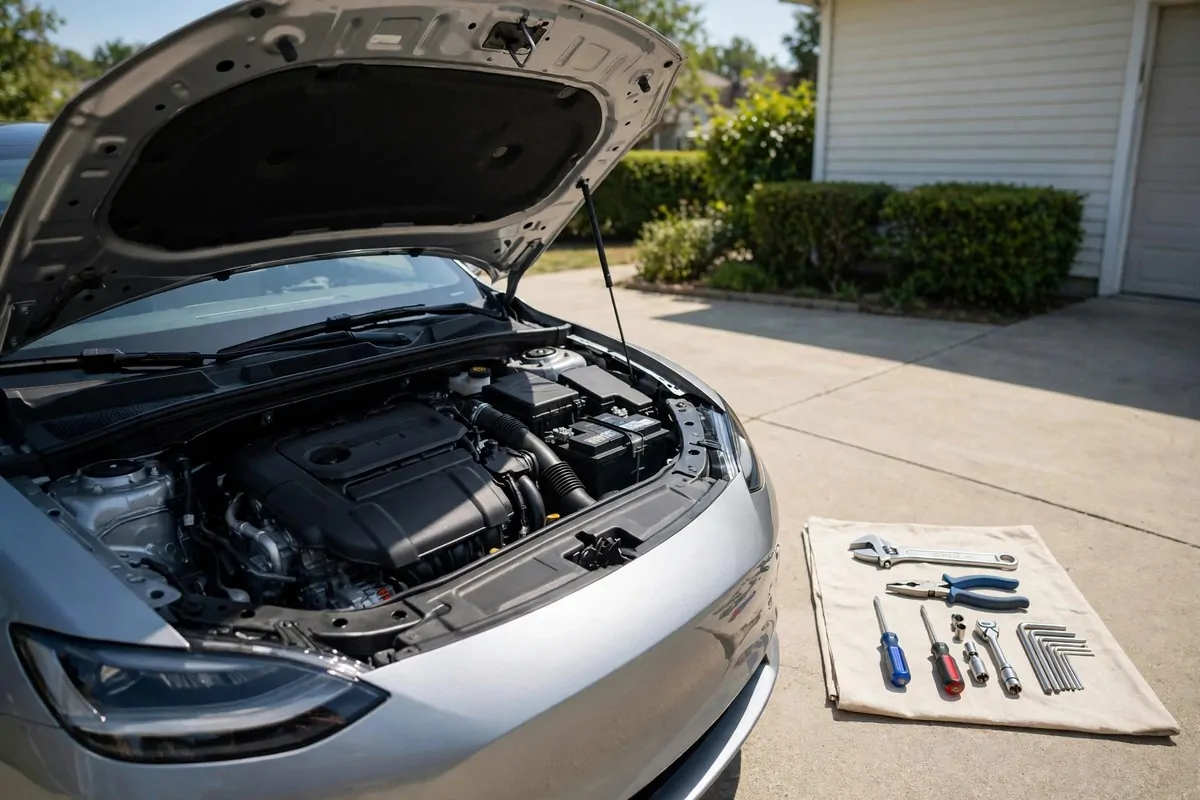
13 Car Maintenance Tasks You Can Do Yourself to Save Money
The garage bill lands, your stomach drops, and you wonder how a small job turned into a big number. You want a car that runs well, but you also want to save money instead of paying for every little job. I know that sinking feeling well, because most car advice sounds like it was written for people with a full tool kit and a free weekend.
This post is different. You will walk away with thirteen clear car tasks you can do at home with basic tools, and each one keeps cash in your pocket. Pick one, try it this weekend, and feel the difference by Monday.
Before we start, here is the deal in plain words. You do not need to be a mechanic, you do not need costly gear, and you do not need a whole day. You need your car handbook, a few basic tools, and a calm hour on a dry day.
Six Quick Checks That Keep Your Car Healthy And Your Wallet Happy
1. Check Your Tyre Pressure Monthly And Save Money At The Pump
When did you last check your tyre pressure? Most people only think about it when a tyre looks flat, and by then the car has been working harder than it needs to for weeks.
Here is a fact worth knowing. The United States Department of Energy says proper tyre pressure can improve fuel economy by up to 3 percent. What it means for you is simple: a free five minute check at a petrol station can cut the fuel you burn on every trip.
Do it today in three steps.
- Find the right pressure on the sticker inside the driver door or in your handbook, not the number on the tyre wall.
- Check the pressure when the tyres are cold, and add air until each tyre matches the sticker.
- Check the spare too, and repeat the check once a month and before a long trip.
Watch out for checking tyres after a long drive, because warm tyres read higher than they truly are. A good first result is a car that rolls a little freer and a fuel gauge that drops a little slower. You will also spot a slow leak early, before it turns into a flat tyre on a wet road.
2. Change Your Engine Oil On Time So Your Car Lasts For Years
Does your engine sound rougher than it used to, or has the oil on the dipstick turned dark and thick? Old oil is one of the quietest ways a car loses life, because it stops guarding the moving parts inside the engine.
Here is a fact from the United States Department of Energy. Using the oil grade your car maker calls for can improve fuel economy by 1 to 2 percent compared with the wrong grade. What it means for you is that the right oil saves fuel and keeps the engine turning freely, so check the grade in your handbook before you buy.
Do it today in three steps.
- Warm the engine for a few minutes, then park on flat ground and switch it off.
- Pull the dipstick, wipe it clean, push it back in, and read the level and the colour.
- Top up with the grade your handbook lists if the level sits low, and book a full change when the oil looks dark or the handbook mileage is due.
Watch out for topping up past the full mark, because too much oil can harm the engine just as low oil can. A good first result is a level that sits between the two marks and an engine that sounds smooth and calm. If the oil looks milky or smells of fuel, stop and ask a trusted mechanic to look at it.
3. Swap A Dirty Engine Air Filter In Ten Minutes With No Tools
Ever pressed the pedal and felt the car hold back, like it was breathing through a blocked nose? A dirty engine air filter does just that, because it chokes the air the engine needs to burn fuel cleanly.
This job takes ten minutes and no skill at all, and a clean filter helps the engine pull better and use fuel more cleanly. Pop the bonnet, find the black filter box, and lift the lid to see the filter inside. If it looks grey and clogged with dust and leaves, it is time for a fresh one.
Do it today in three steps.
- Open the filter box with the clips or screws on the lid, and note which way the old filter sits.
- Lift the old filter out, wipe the box clean with a dry cloth, and drop the new one in the same way round.
- Close the lid, fasten the clips, and take the car for a short drive to feel the difference.
Watch out for forcing the lid shut when the filter sits wrong, because a gap lets dirty air straight into the engine. A good first result is a filter that sits flat, a lid that shuts with ease, and a car that picks up a touch more keenly. Keep the old filter in a bag until you are sure the new one fits well.
4. Top Up Your Screen Wash And Coolant Before They Run Dry
Picture a muddy motorway on a wet night, and your washers puff out nothing but air. Empty screen wash is a small thing until you need it, and the same goes for coolant on a hot day.
Both jobs take five minutes and both guard parts that cost far more to fix than the bottles do. Screen wash keeps your view clear, and coolant keeps the engine from running too hot. A quick look under the bonnet once a month keeps both topped up.
Do it today in three steps.
- Open the bonnet and find the washer bottle and the coolant tank, using the marks in your handbook.
- Fill the washer bottle with screen wash and top the coolant to the line marked on the tank.
- Test the washers and look under the car for any drips after a short drive.
Watch out for opening the coolant cap on a hot engine, because the tank holds pressure and hot liquid can spray out. Wait until the engine is cold, and stop if you see leaks or the level keeps dropping. A good first result is clear washers that spray well and a coolant level that holds steady for weeks.
5. Rotate Your Tyres At Home And Make Every Set Last Longer
Have you noticed the front tyres wearing down faster than the rear ones? That is normal, because the front tyres do the steering and most of the braking, so they wear first.
Swapping the tyres around evens out the wear, and that means you buy a full set later instead of two tyres now and two more in a few months. The job needs a jack, a wheel brace, and a flat patch of ground, plus care at every step. If you feel unsure at any point, stop and let a tyre shop do it.
Do it today in three steps.
- Park on flat ground, set the handbrake, and loosen each wheel nut a little before you lift the car.
- Jack one corner up, swap the wheel with the one from the other end on the same side, and tighten the nuts by hand.
- Lower the car, tighten the nuts in a star pattern, and check them again after a short drive.
Watch out for working on soft or sloping ground, because a jack can slip and that is never worth the risk. A good first result is even wear all round and a car that feels steady and true on the road. Check the handbook for the right swap pattern for your car, since some tyres must stay on the same side.
6. Keep Your Battery Terminals Clean So Cold Mornings Never Catch You Out
Turn the key on a cold morning and hear nothing but a slow groan? Dirty battery posts are a common cause, because a crust of grime blocks the power from reaching the starter.
A clean set of posts takes fifteen minutes and can save a flat morning and a call for help. You need gloves, an old toothbrush, and a jug of warm water with a spoonful of baking soda mixed in. The crust fizzes off, and the posts shine again.
Do it today in three steps.
- Switch everything off, put gloves on, and undo the negative cable first, then the positive one.
- Scrub the posts and the cable ends with the warm soda water and the old toothbrush.
- Dry the posts well, refit the positive cable first and then the negative one, and tighten both snugly.
Watch out for touching both posts at once with a metal tool, because a short spark can burn you and harm the battery. If the battery case looks swollen or cracked, stop and ask a trusted mechanic. A good first result is a car that starts with a quick, strong turn, even on a cold morning.
7. Change Your Windscreen Wipers In Minutes And See Clearly In Rain
Do your wipers smear the rain into streaks instead of clearing it? Worn blades are a small fault with a big effect, because a smeared windscreen hides the road at the worst moment.
New blades cost little and fit in minutes, and the change is clear the first time it rains. Lift the wiper arm, press the small clip, and slide the old blade off. The new one clicks into the same slot, and you are done.
Do it today in three steps.
- Lift one wiper arm away from the glass and lay a folded towel on the windscreen under it.
- Press the clip, slide the old blade off, and slide the new one on until it clicks.
- Do the same on the other side, then test both blades with the washers.
Watch out for letting a bare wiper arm snap back onto the glass, because it can crack the windscreen. That is why the towel sits there as a guard. A good first result is a clean, quiet sweep with no streaks and no chatter, even in heavy rain.
8. Check Your Brake Pads Through The Wheel And Spot Wear Early
When did you last look at your brakes? Most people wait for a squeal, but by then the pads may be thin and the discs may be next in line for a costly repair.
A quick look through the wheel spokes takes two minutes and tells you a lot. Shine a torch through the spokes and look at the pad thickness against the disc. If the pad looks thinner than a few millimetres, or you see a deep groove, it is time to ask a trusted mechanic to check it.
Do it today in three steps.
- Park on flat ground, set the handbrake, and turn the steering so you can see through the spokes.
- Shine a torch on each front pad and note how much pad sits between the metal back and the disc.
- Listen on your next drive for squeals or a grinding sound, and act fast if you hear either one.
Watch out for putting off a brake check, because worn pads can harm the discs and the repair bill grows fast. A good first result is pads with clear thickness left and quiet, smooth braking. If you hear grinding, stop driving and get help at once, because metal on metal means the pads are gone.
9. Clean Your Headlights With Toothpaste And Drive Safer After Dark
Do your headlights look cloudy and yellow, even after a wash? Hazy plastic scatters the light, so less of it reaches the road and night driving feels harder than it should.
A tube of plain toothpaste and a soft cloth can bring back the shine in half an hour, and it works because the mild grit in the paste polishes the haze away. Rub a small amount over the lens in circles, wipe it clean, and repeat until the plastic looks clear. Finish with a thin coat of car wax to guard the shine.
Do it today in three steps.
- Wash the headlights with soap and water, then dry them well.
- Rub a pea sized amount of plain white toothpaste over each lens in small circles.
- Wipe the paste off, check the shine, and repeat once more if the haze is still there.
Watch out for using a rough cloth or a harsh cleaner, because scratches make the haze worse. A good first result is a lens you can see through clearly and a beam that reaches further down the road. Test the lights on a dark street and enjoy the difference.
10. Wash And Wax Your Car By Hand To Protect The Paint From Rust
Does your car wear a coat of road grime all winter, with salt and dirt sitting on the paint for weeks? That grime holds damp against the paint, and damp is what lets rust start in tiny chips and seams.
A hand wash and a coat of wax take an hour, and the wax leaves a thin shield that sheds water and dirt. I wash my car on a Sunday morning, and the hour feels calm and slow, like time set aside just for the car.
Do it today in three steps.
- Rinse the car well, wash it with car shampoo and a soft sponge, and rinse again.
- Dry the car with a soft towel so water spots do not form on the paint.
- Rub a thin coat of wax over one panel at a time, let it haze, and buff it off with a clean cloth.
Watch out for washing in bright sun, because soap dries fast and leaves marks that are hard to shift. A good first result is paint that feels smooth and beads water when it rains. Pay extra care to the sills and wheel arches, since those are the spots where rust shows first.
11. Replace A Blown Fuse Or Bulb Yourself With The Handbook Open
Has a brake light or a cabin light just stopped working, and you dread the garage bill for a two minute fix? A blown bulb or a blown fuse is one of the easiest jobs on a car, and the handbook shows you where each one lives.
The fuse box sits under the dash or under the bonnet, and each fuse has a number that matches a simple chart in the handbook. Pull the dead fuse with the small tool in the box, and hold it up to the light to see if the wire inside has broken. A bulb works the same way: twist the old one out and fit a fresh one of the same type.
Do it today in three steps.
- Switch the car off, open the fuse box, and find the right fuse on the chart.
- Pull the fuse, check the wire inside, and push a fresh one of the same rating into place.
- Test the light or the part it feeds, and keep a spare fuse in the glove box for next time.
Watch out for fitting a fuse with a higher rating than the one you took out, because that can let too much current through and harm the wiring. A good first result is a light that works again and a fuse that sits snug in its slot. If a new fuse blows at once, stop and ask a trusted mechanic to find the fault.
12. Listen For New Noises Early And Catch Small Faults Before They Grow
Has your car started to make a new sound, a whine, a rattle, or a knock you cannot place? New noises are the car telling you something early, and the drivers who listen are the ones who catch faults while they are still small.
Here is a fact from the United States Department of Energy. Fixing a car that is clearly out of tune can improve fuel economy by an average of 4 percent. What it means for you is that a rough idle or a sluggish pull is not just a quirk, it is fuel slipping away, so act while the fix is still small.
The same source gives a sharper warning. Fixing a serious fault, such as a faulty oxygen sensor, can improve fuel economy by as much as 40 percent. What it means for you is that a warning light or a sudden thirst for fuel deserves a look now, not next month.
Do it today in three steps.
- Turn everything off, drive a short quiet route, and note when the sound shows up.
- Write down what the sound is like and when it happens, so you can tell a mechanic clearly.
- Check the simple things first, such as the oil level, the coolant level, and any warning light on the dash.
Watch out for turning the radio up to hide a noise, because the fault only grows while you wait. A good first result is a clear note of the sound and a fix booked before the fault grows. If the car feels unsafe or a red warning light comes on, stop driving and get help at once.
13. Follow The Service Schedule In Your Handbook And Skip Surprise Bills
Do you treat the service schedule as a rough guess, or do you follow it like a map? The handbook lists each job by miles and by months, and those numbers come from the people who built your car.
Here is a fact that puts the stakes in plain words. The AAA Your Driving Costs study for 2024 puts the average cost to own and run a new car at $12,297 a year. What it means for you is that a car is one of the biggest costs in a household, so the small jobs in this post guard a sum worth guarding.
Do it today in three steps.
- Open your handbook and find the service table for your model and year.
- Write the next three jobs and their due dates on a card and keep it in the glove box.
- Tick each job off as you do it, and set a phone reminder for the next due date.
Watch out for letting a small job slip past its date, because one missed change can wear parts that cost far more to fix. A good first result is a card with three clear dates and a car that gets what it needs on time. That simple habit is how a car stays sound for years, and how you keep the big bills away.
Key Takeaways To Help You Save Money On Car Care Every Month
- Check tyre pressure each month, because soft tyres burn more fuel on every trip.
- Keep oil fresh and at the right grade, so the engine turns freely and lasts longer.
- Fit a clean air filter when the old one looks grey, so the engine can breathe well.
- Top up screen wash and coolant on a cold engine, so a clear view and cool running never fail you.
- Swap tyres around on a regular basis, so wear stays even and each set lasts longer.
- Clean battery posts when starts turn slow, so cold mornings never leave you stuck.
- Fit fresh wiper blades at the first sign of streaks, so rain never hides the road.
- Look at brake pads through the spokes each month, and act fast on squeals or grinding.
- Polish cloudy headlights with plain toothpaste, so night driving feels safe again.
- Wash and wax by hand on a regular basis, so paint stays smooth and rust stays away.
- Swap a blown fuse or bulb with the same rating, and keep spares in the glove box.
- Note new noises at once and fix small faults early, before they grow into big bills.
- Follow the handbook service dates, because a car looked after on time costs less to run.
What To Do First Today In Three Short Steps For Your Car
Start small and start now, because three short steps today beat a perfect plan next month. I still run through these checks on a dry Sunday, and the car repays the hour with smooth starts and quiet bills.
- Check your tyre pressure and your oil level today, and write down what you find.
- Pick one more job from this list, such as the wipers or the air filter, and do it this weekend.
- Write the next three service dates on a card and keep it in the glove box.